A water softener in San Antonio has a hard job. SAWS says the typical hardness of the water it provides ranges from 15 to 20 grains per gallon, which is very hard on any scale. A softener sized for that keeps scale off faucets, glass and pipes and lets soap lather again. This page explains how softeners work, how they are sized for SAWS water, and what to ask before you buy one.
Water Filtration San Antonio is an independent referral service, not an installer or plumber. When you send the form, your details go to an independent local water treatment pro who can contact you and quote the work.
What hard water does in a San Antonio home
Hardness is caused mainly by calcium and magnesium dissolved in the water. SAWS says the hardness in its water comes from calcium carbonate found naturally in water from the Edwards and the Trinity Aquifers. The US Geological Survey grades water by the amount of hardness as calcium carbonate: 0 to 60 mg/L is soft, 61 to 120 moderately hard, 121 to 180 hard, and anything over 180 very hard. At about 17 mg/L per grain, SAWS’s 15 to 20 grains works out to roughly 255 to 340 mg/L.
You see that hardness every day. In hard water, soap reacts with the calcium to form soap scum, and you need more soap or detergent to get things clean. Deposits build up on dishes, fixtures and basins, and scale can build up inside pipes. The EPA lists “water softener needed to treat hardness” next to scaly deposits and soap that will not lather.
- A white crust around faucets, shower heads and drains
- Spots and film on glasses after the dishwasher
- Shower glass that clouds again soon after cleaning
- Shampoo and soap that need more to lather
- Scale in kettles, coffee makers and the water heater
What hard water is not, according to SAWS, is a health hazard. A softener is a choice about scale, soap and cleaning, not about safety. Other water utilities say the same thing in other words: using a softener is a matter of personal preference and may not improve the safety of water as it relates to health.

How a water softener works
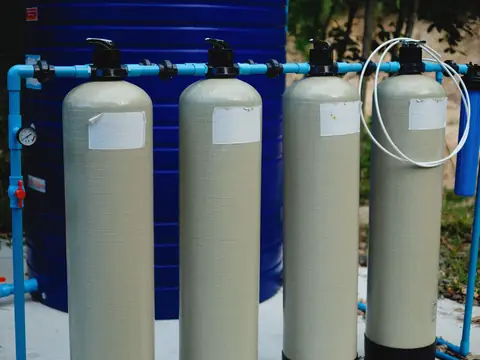
A softener works to remove the high concentrations of calcium and magnesium that cause hard water. The kind NSF/ANSI 44 covers is the ion exchange softener. Resin beads inside the softener trap the calcium and magnesium and exchange them for sodium or potassium. When the beads are full, the unit regenerates: a concentrated salt or potassium solution, the brine kept in the brine tank, removes the calcium and magnesium from the beads, and that waste water goes down the drain.
That trade is why a softened home has a little more sodium in its water. Water utilities put it plainly: in home softeners, sodium is added to the water in exchange for the hardness removed. If you are on a sodium-restricted diet, ask your doctor, as utilities advise. NSF/ANSI 44 covers softeners regenerated with sodium or potassium chloride, so ask the installer whether potassium chloride suits your system.
The standard to ask about
NSF/ANSI 44 covers residential water softeners that use a cation exchange resin regenerated with sodium or potassium chloride. Ask which unit in the quote is certified to it.
Sizing a softener for 15 to 20 grains
Softener capacity is counted in grains: how much hardness the resin can hold before it has to regenerate. Penn State Extension sets out the arithmetic: multiply your water’s hardness in grains per gallon by the gallons your household uses in a day, and you have the grains the softener must remove each day.
| Example only | Hardness | Gallons a day (made-up) | Grains a day |
|---|---|---|---|
| Lower SAWS figure | 15 gpg | 200 | 3,000 |
| Upper SAWS figure | 20 gpg | 200 | 4,000 |
| Upper figure, more use | 20 gpg | 400 | 8,000 |
The gallons in that table are placeholders to show the method, not a measure of any home. Your installer should test your water and ask how many people live in the house, how many bathrooms you have and whether you irrigate from the same line, then size the unit from those answers. Ask how often the recommended unit is expected to regenerate at your hardness and use. Ask the installer to show you the arithmetic behind the size they recommend.
Hard water at home? Ask an independent San Antonio pro for a quote.
Request a quoteSalt or potassium
NSF/ANSI 44 covers softeners regenerated with either sodium chloride (softener salt) or potassium chloride. Both do the same job of recharging the resin. With potassium chloride, the resin trades potassium rather than sodium for the hardness. Ask the installer whether the unit you are quoted is set up for either, and what the maker recommends.
Water softener or water conditioner?
Many people say “water conditioner” when they mean a softener, and search engines treat the two words as one search. The word can mean a salt-based ion exchange softener or a salt-free unit, and salt-free units are a different technology from ion exchange.
If you are quoted a salt-free unit, ask what it is certified for. NSF/ANSI 44 is written for ion exchange softeners regenerated with sodium or potassium chloride, so a salt-free unit falls outside that standard as it is described. TCEQ’s general advice applies to every piece of water treatment equipment: choose a unit certified by NSF, Underwriter’s Laboratory or the Water Quality Association to remove the contaminant you care about, and make sure it is certified for that contaminant. The salt-free softener article goes into the questions to ask.

Softened water and your water heater
Scale inside a water heater is one of the reasons people soften. There is a second side to it. Water utilities warn that some softening systems have the potential to increase the corrosivity of the water, which in turn can damage the anodes in your water heater. Ask the installer how the softener will be set for your water and whether the anode in your water heater should be checked.
Who may install a softener in Texas
Texas licenses this trade. Under TCEQ’s Water Treatment Specialist rule, any individual who under contract installs, exchanges, connects, maintains or services water treatment equipment needs a Water Treatment Specialist license unless exempt. Plumbers licensed under Texas Occupations Code Chapter 1301 are exempt. Class II covers installing and servicing softeners. In the city, a replacement or an install into an existing pre-plumbed loop falls under San Antonio’s Limited Service Repair permit; other softener work needs a regular plumbing permit. The installation page explains both.
What to ask before you buy
- What hardness did you measure, and how did you size the unit from it?
- Is the unit certified to NSF/ANSI 44?
- Is it set up for salt, potassium or both?
- Which Texas license do you hold, and which San Antonio permit applies?
- Where will the drain line run, and is there a bypass valve?
- What does the maker say about maintenance, and what is in the written quote?
Already have a softener that is not keeping up? Start with softener repair or softener service. Want filtered or RO drinking water as well? See water treatment in San Antonio.


Questions people ask
Do I really need a water softener in San Antonio?
No one needs one for health: SAWS says hard water is not a health hazard. People choose one because SAWS water runs 15 to 20 grains per gallon, which leaves scale on fixtures, spots on dishes and soap scum.
Is 20 gpg hard water?
Yes, very hard. 20 grains per gallon is roughly 340 mg/L as calcium carbonate, and the USGS calls anything over 180 mg/L very hard.
Does Texas have hard or soft water?
It depends on the supply. For SAWS customers, SAWS gives a typical range of 15 to 20 grains per gallon. Other Texas utilities publish their own figures in their annual water quality reports.
How much does a water softener cost in San Antonio?
This site prints no prices. The cost depends on the unit, its capacity, whether a loop is already plumbed and which permit applies. Ask for a written quote that names the unit and its NSF/ANSI 44 certification.
Does a softener add salt to my water?
A salt-based softener adds a little sodium in exchange for the hardness it removes. If you are on a sodium-restricted diet, ask your doctor, and ask the installer about potassium chloride.
Is a water conditioner the same as a softener?
Sometimes the words mean the same salt-based unit. Salt-free conditioners are a different technology from ion exchange, so ask what any salt-free unit is certified for.
